
Cooling Fan Size Guide: Complete Fan Size Selection

Updated: Oct 1
Fan size selection is not simply a matter of bigger is better. The right choice depends on your system architecture, heat source characteristics, and real-world operating environment. As high-power devices such as AI servers, electric vehicles, and industrial computers become increasingly prevalent, selecting the correct fan size has become a critical factor in any thermal management design.
Fan size directly impacts: cooling efficiency, system noise, power consumption, space utilization, service life, and overall system reliability.
1. Common Cooling Fan Sizes at a Glance
Cooling fans are specified by Length × Width × Thickness in millimeters. An 80 × 80 × 25 mm fan, for example, has an 80 mm square frame and is 25 mm deep. The chart below lists the standard cooling fan sizes used in industrial, telecom and computing equipment, with inch equivalents, common thicknesses and typical airflow.
Fan size (mm) | Inches | Common thickness (mm) | Typical airflow (CFM)* | Typical applications |
25 × 25 | 0.98" | 10 | 1–3 | Small modules, embedded boards |
30 × 30 | 1.18" | 10, 15 | 2–6 | Embedded modules, optical transceivers |
38 × 38 | 1.50" | 28 | 8–25 | ★ Pendec 3828 · Compact high-pressure industrial modules |
40 × 40 | 1.57" | 10, 20, 28, 56 | 5–40 | ★ Pendec 4028 / 4056 · 1U servers, network switches, industrial control |
50 × 50 | 1.97" | 10, 15, 20 | 8–20 | Telecom modules, instruments |
60 × 60 | 2.36" | 15, 25, 38 | 10–60 | Industrial PCs, switches, compact chassis |
70 × 70 | 2.76" | 15, 25 | 20–50 | Power modules, medical devices |
80 × 80 | 3.15" | 15, 25, 38 | 25–100 | Power supplies, inverters, mid-size equipment |
92 × 92 | 3.62" | 25, 38 | 30–130 | Chassis cooling, network appliances |
120 × 120 | 4.72" | 25, 38 | 50–250 | Servers, electrical enclosures, PC cases |
140 × 140 | 5.51" | 25 | 60–150 | Low-noise systems, workstations |
172 × 150 | 6.77" | 51 | 200–350 | AC cabinet fans, telecom racks |
200 × 200+ | 7.87"+ | 20–70 | 250–650 | Large cabinets, ventilation |
★ = size available in the Pendec product range. *Typical free-air airflow across standard- to high-speed models. Actual airflow depends on RPM, blade design and operating voltage. Always confirm with the model datasheet and its PQ curve.
Common thicknesses are 10, 15, 20, 25 and 38 mm. High-performance 40 mm server fans such as the Pendec 4028 and 4056 use 28 mm and 56 mm frames to reach higher static pressure. Greater thickness generally means higher static pressure, greater airflow and improved cooling capacity.
2. How to Measure a Cooling Fan Size? How Size Affects Performance
When you replace a fan or design a new enclosure, measure the existing fan correctly first. A wrong reading usually means the new fan will not fit the opening or the available depth.
1)Frame size: measure the square frame edge to edge, not the blade diameter.
2)Thickness: measure the frame depth from the intake side to the exhaust side.
3)Check the label and frame: confirm the rated voltage, connector type, and the airflow and rotation arrows molded on the frame.
📌 Application example: A field technician replacing a failed fan in a control cabinet measures a 92 mm frame and a 25 mm depth. The correct replacement is a 92 × 92 × 25 mm fan at the same voltage, with equal or higher airflow at the cabinet's operating pressure.
Fan Size vs. Airflow
Larger fans move more air due to greater blade swept area. A larger fan can deliver high airflow at lower RPM, resulting in lower noise and higher efficiency. For the same airflow requirement, a 120mm fan operates at far lower RPM than a 40mm fan — making larger fans inherently quieter.
Size vs. Static Pressure
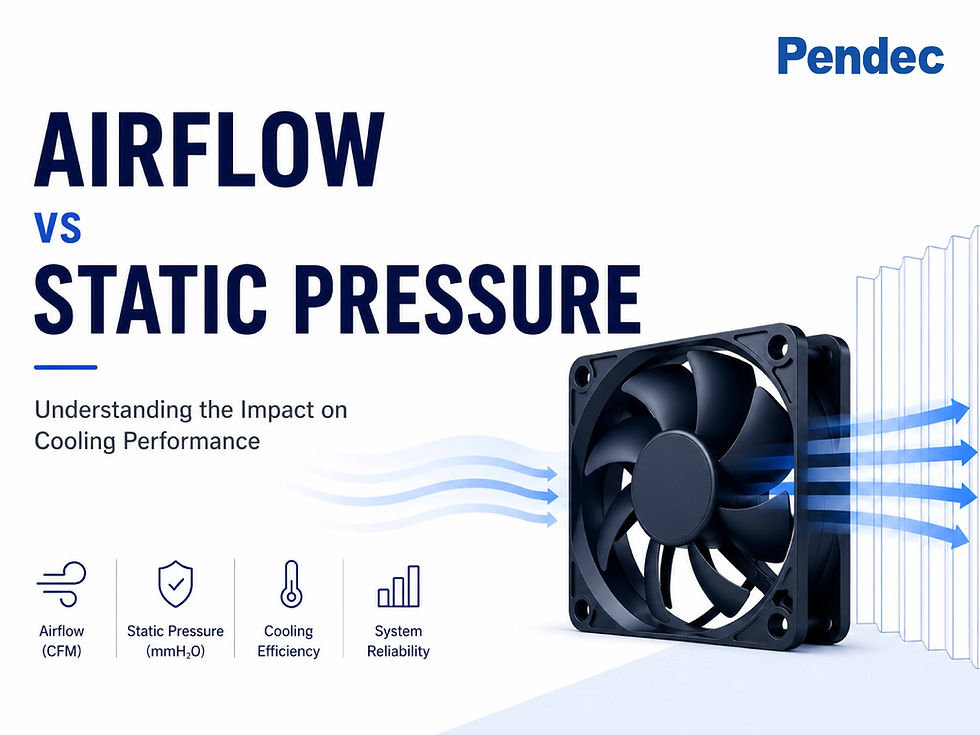
Static pressure measures a fan's ability to push air through resistance — essential for applications involving heatsink fins, dust filters, liquid cooling radiators, or dense chassis. Smaller fans, running at higher RPM, can actually produce higher static pressure with more focused airflow. Open-space cooling favors large high-airflow fans; high-impedance systems should prioritize high static pressure ratings.
Why Thickness Matters
For the same footprint, a thicker fan offers deeper blades, a larger motor, and greater air compression capability. For example, a 120x25mm fan suits standard PC cooling, while a 120x38mm fan is designed for demanding industrial and server high-static-pressure applications.
3. Size Recommendations by Application
✔ 1U Servers: Extremely space-constrained — typically require 40mm high-RPM fans with high static pressure and proven durability.
📌 Application example: A 1U chassis is only 44.45 mm tall, so 40 mm is the largest fan frame that fits. Rows of 40 × 40 mm fans must push air through dense heatsinks and drive bays, so static pressure matters more than size. The Pendec 4028 suits standard 1U and switch airflow, and the deeper Pendec 4056 adds static pressure for higher-density boards. Learn more in Server Thermal Management.
✔ Mini PCs / Embedded Systems: 30–60mm fans balancing thermal performance with low noise output.
✔ Industrial PCs (IPC): 60–92mm fans selected for high-temperature, dusty, and continuous-operation environments.
✔ Standard ATX Chassis: 120–140mm fans allow low-RPM operation for quiet, effective cooling.
✔ Large Servers / Cabinets: Fan arrays requiring precise calculation of system resistance and total airflow requirements.
4. How to Calculate What Size Fan You Need
Fan size should come from the thermal requirement, not from habit. Use this standard airflow estimate:
Required airflow (CFM) ≈ 3.16 × Heat load (W) ÷ ΔT (°F)
Metric: CFM ≈ 1.76 × Heat load (W) ÷ ΔT (°C)
ΔT is the allowable temperature rise between intake air and exhaust air. For a full walkthrough, see How to Calculate Cooling Requirements for Electronics.
✔ Step 1 – Calculate the required airflow from the heat load and allowable ΔT.
✔ Step 2 – Add margin for system impedance. Filters, heatsink fins and cables reduce the airflow a fan actually delivers. As a rule of thumb, select a fan with a free-air rating of about 1.5–2× the calculated airflow, then verify it on the fan performance (PQ) curve.
✔ Step 3 – Fit the largest frame the space allows. At the same airflow, a larger frame runs slower and quieter and lasts longer.
📌 Application example: An industrial controller dissipates 200 W with an allowable internal rise of 10 °C. Required airflow ≈ 1.76 × 200 ÷ 10 ≈ 35 CFM. With 1.5–2× margin, the target free-air rating is about 55–70 CFM, which fits one 80 × 80 × 38 mm fan or one 92 × 92 × 25 mm fan. Where height is limited, two 60 mm fans in parallel are an alternative.
5. Key Principles for Fan Size Selection
Applying these principles ensures a truly systematic approach to fan size selection — avoiding costly mistakes from incorrect sizing.
✔ Start With Thermal Requirements: Evaluate total system power dissipation, heat source locations, space constraints, airflow paths, and acceptable noise levels before choosing a size.
✔ Prioritize Static Pressure for High-Impedance Systems: Systems with heatsink fins, dust filters, liquid cooling radiators, or narrow airflow channels should use high-static-pressure fans, greater fan thickness, or increased fan count.
✔ Default to Larger, Slower Fans Where Space Allows: 120mm or 140mm fans at reduced RPM deliver lower noise and higher reliability — the current mainstream design direction for quality thermal management.
✔ Match Fan to Airflow Path: Front-to-back or bottom-to-top airflow arrangements prevent interference between fans and eliminate hotspots, turbulence, and thermal dead zones.
✔ Account for Environment in Industrial Applications: Industrial deployments must address high temperatures, dust, oil contamination, and continuous operation. Select dual ball bearing, IP (Ingress Protection) rated, PWM (Pulse Width Modulation) speed-controlled fans with proven reliability ratings.

AC, DC and EC Fan Availability by Size
✔ DC fans cover the full range from 25 mm to 200 mm+, at 5 / 12 / 24 / 48 V, with options for PWM speed control, FG tachometer and RD alarm signals.
✔ AC fans are most common at 80 mm and above (80, 92, 120, 172 and 200 mm+). They run directly on 115 / 230 V mains and suit cabinets and ventilation. See AC Fan vs DC Fan.
✔ EC fans are mostly 120 mm and larger. They combine AC input with the efficiency of a brushless DC motor.
✔ Sealed and waterproof versions are available in many sizes for outdoor and humid environments. See IP Ratings in Cooling Fans.
7. Conclusion: Get the Size Right, Get the Cooling Right
✔ Fan size = Length × Width × Thickness (mm). Standard sizes run from 25 mm to 200 mm+.
✔ Measure the frame, not the blades, and confirm thickness and voltage when replacing a fan.
✔ Size from the heat load: CFM ≈ 3.16 × W ÷ ΔT(°F), then add margin for system impedance.
✔ Larger and slower is quieter, but compact, dense systems need thicker, high-static-pressure fans.
✔ Always verify on the PQ curve at the system's real operating point.
Fan size selection is the foundation of any effective thermal management system. Large fans offer low noise and high airflow advantages; small fans suit high-density, high-static-pressure environments; and fan thickness directly determines static pressure and cooling capacity. Only by balancing space, airflow path, noise, and power consumption together can you select the specification that truly meets your needs. See How to Reduce Fan Noise.
Pendec Electronics specializes in compact, high-static-pressure DC cooling fans for servers, network equipment and industrial systems, where space is tight and airflow resistance is high. The range includes the 38 × 38 × 28 mm, 40 × 40 × 28 mm and 40 × 40 × 56 mm DC axial fans, intelligent fans for network switches, and waterproof fan modules. Our engineers can help you choose the right size, thickness and PQ performance for your system.
Additional models and configurations are continuously expanding. Contact us for the latest product availability and a customized fan size selection recommendation.


Comments